
Reducing NOx emissions from cyclone boilers
McDonnell Engineering designs and engineers "over-fire air" systems for cyclone boilers as well as undertaking other projects for various types of plants
In a recent cyclone boiler study, Burns & McDonnell and AEA Technology have used CFX to develop an integral model of the boiler, five cyclone furnaces and the "over-fire air" (OFA) system. Since no two boilers are identical, CFX is a valuable tool for this work.
It allows Burns & McDonnell to customize the OFA system for each boiler by rapidly screening possible solutions and then optimizing the NOx reduction and thermal efficiency while minimizing boiler degradation. Traditionally, CFD has only been used to model a single cyclone furnace in isolation because of the highly swirled flow and complex physical processes in the cyclone.
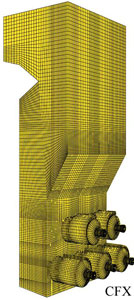
In cyclone boilers, crushed coal is combusted in separate high-temperature chambers, called cyclone furnaces, before the hot gaseous products enter the main boiler furnace where most of the heat is extracted. The purpose of the cyclone furnace is to retain most of the incombustible ash for subsequent tapping off as semi-molten slag.
However, the high temperatures required to create the slag layer in the cyclone furnace can have the unwanted side effect of increasing NOx emissions. NOx can be reduced by diverting some of the combustion air from the cyclones to the main boiler, where it is introduced above the flame region as OFA.
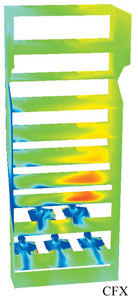
The results showed that reductions of more than 50% in NOx could be achieved by introducing up to 14% of the combustion air as over-fire air on the rear wall of the furnace. Furthermore, the introduction of a biased over-fire airflow improves the air distribution and reduces the size of the low-oxygen region near one of the side walls above the cyclones.
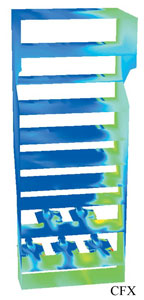
CFX results show that NOx reductions of over 50% can be achieved.
About the Author: To contact, Mike Walz, Burns & McDonnell Engineering, USA, call 816-822-3192, or email, mwalz@burnsmcd.com. To contact Mark Turrell, AEA Technology, UK, call +44 1235 432956, or email, cfx.support@cfx.aeat.com. This article first appeared in AEA Technology's (www.aeat.com/cfx) CFX Update, 1999. It was submitted by Chris Reeves, AEA Technology, 888-827-2356, and reprinted with the approval of AEA Technology and Burns& McDonnell Engineering.
Subscribe to our free e-mail newsletter.
Click for a free Buyer's Guide listing.