
Perkins Provides Life Support for Salmon
Located well off the power grid in the remote Campbell River area of British Columbia, Canada, McMann's workplace—the Little Bear Bay salmon hatchery—depends on a pair of 166 kW gensets manufactured by Perkins' master distributor Simson-Maxwell of Vancouver for its varied electrical demands.
Those gensets ensure, McMann said, that the eggs become fish and the fish eventually become table fare—a man-made, environmentally friendly source of healthy protein.
Powered by Perkins' 1300 Series engines, the gensets provide electricity for all the predictable aspects of an operation at a remote site, including heat, lights, communications, etc. They also pump the juice to the sophisticated temperature and environmental systems needed to nurture and hatch salmon eggs into salmon fry and the growth of the fry until they are ready for salt water.
"Our industry has come a long way in the past 10 years or so," McMann said. "The commercial raising of salmon in British Columbia is a significant industry. BC produces about 35,000 tons of fish a year and has become the world's fourth largest producer of farmed salmon. In fact, salmon farming is BC's largest agricultural export crop."
McMann's Little Bear Bay hatchery is part of Noram Aquaculture, a major player in the British Columbia salmon farming market.
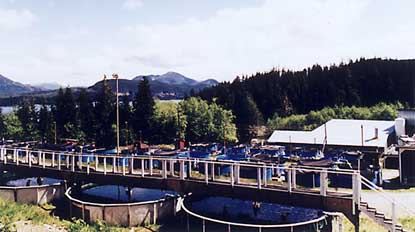
Two,166 kW Perkins gensets power the Little Bear Bay salmon hatchery in British Columbia.
"Mike's operation at Campbell River is a great example of Perkins power in action," said Ian Laidlaw, Simson-Maxwell's Perkins product manager. "They're about 30 miles from the nearest electrical power source, and our genset capability is vital to them and the millions of eggs they process at a time."
As nutritionists around the world endorse the importance of adding more fish to the diet, especially salmon, Laidlaw said Simson-Maxwell's business with the salmon farming industry has been on an upswing over the past few years. "We've grown with the salmon industry," he said. "Not only do we have prime power installations, such as Little Bear Bay, but we've also installed a significant number of gensets for back-up power on salmon farms."
Salmon egg farming is a delicate process at Little Bear Bay. Little Bear Bay grows three and sometimes four "batches" of Salmon eggs a year, averaging about 8 million eggs over the past two years, McMann said.
"We start by purchasing 2.5 million Atlantic salmon eggs at a time from a supplier. Then we manage the complex fresh water system we've developed here that ensures the eggs hatch and the fry can be transferred to a salt water system," he said. "Once in salt water, they continue to be nurtured until they grow to an appropriate size for harvesting."
The Little Bear Bay hatchery sits on a small Pacific Ocean tributary, Pye Creek. McMann said it's Pye Creek's sparkling, clear waters that supply the hatchery, which is at the mouth of the creek, virtually on the Pacific Ocean beach.
Because the fish and eggs are cold-blooded, McMann said temperature control of the fresh water in the tanks remains absolutely vital to their well being. "Cold water slows their growth," he said. "Warmer water speeds it up. And we have to control it, accurately, in order to make it all work."
To control the temperature process, McMann said the hatchery uses a large, reverse refrigeration system powered by the Perkins gensets. Other equipment involved includes systems to balance the flow of oxygen in the hatchery tanks, an ozone generator to keep the water sterilized, and a fish-feeding system.
"It all requires a very scientific balance," McMann said. "And the power we get from our gensets allows us to achieve that balance."
Perkins Engines, based in Peterborough, U.K., ranks among the world's leading suppliers of off-highway, multi-cylinder diesel engines in the 5-2600 horsepower market. More than 300,000 Perkins engines are manufactured every year in 13 countries and are sold in 160. The engines power more than 5,000 different applications for more than 1,000 major equipment manufacturers in the construction, agricultural, power generation, materials handling, defense, marine, and rail markets.
Perkins engines are marketed in the United States and Canada by Perkins Engines, based in Detroit, and by its North America-wide network of more than 800 distributors and dealers.
Edited by April C. Murelio
editor@poweronline.com