
Part 4: IGCC offers graceful, gainful recycling and energy production
Environmental considerations are nudging combined heat and power developers, particularly in the refining industry, to embrace gasification as a way to dispose of waste products gracefully and gainfully.
According to Gary Stiegel, product manager for gasification technologies for the U.S. Department of Energy's National Energy Technology Laboratory, (www.netl.doe.gov), environmental trends now drive the growth in gasification.
"Gasification is basically environmentally driven right now," Stiegel said. "It's a technology that converts any carbon-based feedstock to marketable, high-value products. Many of the projects today are cogeneration and polygeneration facilities producing electricity, hydrogen and steam. Most of the applications are for refineries."
Cost deters development
While gasification isn't a new technology, and the equipment remains readily available, it hasn't quite caught on because of costs. However, that's changing as the learning curve grows and environmental mandates increase the price of conventional generation.
"Right now," said Stiegel, "the major hurdle to overcome is capital costs of the facilities. We need to bring those down even lower than what they are today. The DOE, together with industry, are working to reduce the cost of these facilities. I would say typical greenfield IGCC (integrated gasification combined cycle) plants cost on the order of US$1,100 to US$1,200 per kW."
TECO sold on IGCC
Buoyed by the success of a pilot IGCC plant that produces electricity and steam for its gasification process, TECO Power Services, a unit of TECO Energy, signed a memorandum of understanding to develop an IGCC plant at a CITGO refinery at Lake Charles, LA.
That facility will produce nearly 700 MW using excess refinery gas and 5,000 tons of petroleum coke, a refinery byproduct, daily. TECO Power Services expects the proposed facility to be operational in January 2005. It plans to sell excess electricity to the local grid and provide hydrogen and steam to CITGO. Texaco Power and Gasification Global also have rights to participate in the project.
While the cost of gasification equipment increases investment, tighter emissions controls on existing and new conventional plants help close the gap, according to Mark Senior, a project engineering manager with TECO Power Services, which operates a 250-MW coal-gasification plant at Mulberry, FL.
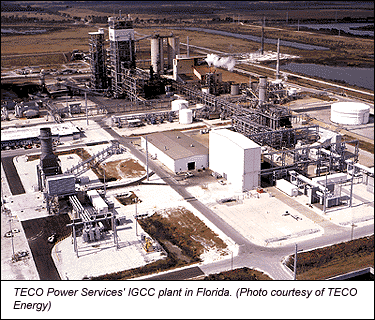
TECO Power Services built the US$303-million plant with about 50% government funding as a test/demonstration facility. Designed to use the thermal energy it produces for its processes, the electricity then goes to Tampa Electric.
"It's very capital intensive," Senior said. "The benefit comes that you can use a very cheap fuel. It'll gasify anything, but it has to be designed for it. It's not the answer for everything, but it's very useful in certain situations."
As environmental regulations become tighter and tighter, IGCC inches closer to the cost of conventional pulverized-coal units, he said, particularly after scrubbers and selective catalytic reduction.
Fuel switch in the works
TECO's plant, which gasified its first coal in July 1996, uses high-sulfur southern Illinois coal, but there are plans to blend Powder River Basin coal and petroleum coke to cut fuel costs.
Built with proven components, the original intent was to test a hot-gas cleanup system that, ironically, never operated because the manufacturer of a ceramic filter material wasn't able to develop a product that could handle the thermal and physical shock without breaking.
The generation process starts with grinding the coal, mixing it with water and pumping it at high pressure into the hot, oxygen-rich gasifier.
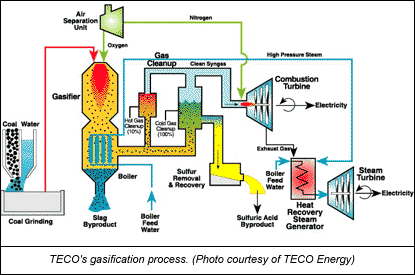
The synthesis gas, 40% hydrogen, 40% carbon monoxide and 20% carbon monoxide, has about 300 Btu/cubic foot, or about 700 less than natural gas. The hot gas routes to a cooler, similar to a boiler, that produces high-pressure steam for process, which adds to the unit's efficiency.
After being cleaned with water to remove particulates, the gas is treated with a solvent to remove hydrogen sulfide and then is re-heated and treated with nitrogen to bring its Btu content down to 180/cu ft. The nitrogen cools the flame and lowers the amount of NOx produced.
CT produces more power with synthesis gas
The combustion turbine, rated at 160 MW on natural gas, produces about 193 MW on the synthesis gas. Since the gas is lower in Btus than natural gas, more is required to fire the CT. "You get a lot more volume coming through that turbine, its output goes up," Senior said.
The remainder of the plant's 250 MW output comes from a heat-recovery steam generator and a turbine. Availability hovers around 86%, and it's getting better.
"It's a constant process of improvement," Senior said. "That availability's due to the learning curve on the gasifier. They've done a lot of work to solve problems in the original plant."
TECO Power Services makes the slag from the gasifier available for use in manufacturing roofing and concrete blocks, while sulfuric acid, also a byproduct, goes into fertilizer production.
Agricultural wastes a potential large market
The agriculture community, with animal and processing wastes, presents a potentially large market for gasification, according to DukeSolutions, Harmony Products and Renewable Energy of Australia. The three are developing several animal-waste gasification plants that for the moment don't include producing electricity, though that's an option if there are favorable rates or other reasons to add generating equipment.
Animal waste, particularly chicken droppings, are a disposal nightmare in poultry-growing areas, blamed for fouling water with excess nitrogen from runoff.
"We hope to ultimately build 30 to 100 of these plants around the U.S., maybe 200 worldwide" said Scott Keeley, general manager of business development for DukeSolutions, which is the energy retail and services arm of Duke Power.
"It's 100% renewable, so we're depending less on foreign sources of energy, which I think is a positive thing," Keeley said. "When litter is just stored in sheds or stored on a field, it decays, releases methane, CO2 and so forth, and those are greenhouse gases. Our process will actually, believe it or not, reduce greenhouse gases."
The trio plans to site the plants in chicken processing areas, ideally at processing sites, which will use the thermal energy for their operations, and Harmony will market organic fertilizer made from the gasifier ash.
The process both gasifies the biomass and burns the gas in the same chamber, which, Keeley said, represents an economical and environmentally friendly way to produce and burn the gas.
Conventional technology works too
Conventional technology, however, also provides useful remedies for waste products. For example, urban wood waste has a value for CHP, according to Market Street Energy (www.mstreetenergy.com) of St. Paul, MN. Electricity will go to Northern States Power under a long-term contract (See also, "Collins relying on biomass CHP").
Market Street Energy plans to add a conventional 25 MW CHP facility to its district heating/cooling operation. The project is being developed and will be owned jointly by Market Street Energy and Trigen-Cinergy Solutions.
According to Doug Maust, vice president of development for Market Street, "With the development of this project, our fuel mix will switch to where waste wood will become our primary fuel."
Market Street's existing facility produces about 1 MW for internal use and burns primarily low-sulfur Kentucky coal along with natural gas, oil and a small amount of urban wood waste. It expects the CHP plant to reduce emissions from Market Street's operation by 600 tons yearly for for SO2 and 280,000 tons yearly for CO2.
The company also expects the facility to consume about 275,000 tons of wood yearly, and there's a ready supply. Sources include construction, tree-trimming and manufacturers of wood products.
"A survey of the metro area suggests that's less than half of the wastewood generated in the area every year," Maust said.
About the author: Joe Palenik covers a variety of power generation topics for trade publications around the world. Check out the first three parts of his CHP series in Power Online's Features & Case Studies section. To contact Palenik, write writer@dmv.com. (Back to top)
Collins relying on biomass CHP
By Joe Palenik
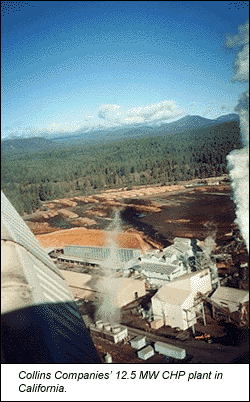
The Collins Companies (www.collinswood.com), like other businesses that use energy heavily, is reworking its energy policies and relies on its 12.5 MW combined heat and power plant at a sawmill in Chester, CA to help the company's bottom line.
The plant, which burns about 300 tons a day of mostly wet wood waste, supplies electricity, thermal energy and an environmentally beneficial way to deal with wood and agricultural wastes.
According to Wade Mosby, a senior vice president for the company, "If you take a look at what's happened this year in the electricity business, I'm sure that every manufacturing plant, at least in the western U.S., is reevaluating what they do, and we're no different."
"What we're trying to do is figure out a strategy," he said. "It obviously will include what generating capacity we have, but also purchasing power for other locations. Chester with the cogen plant is going to be one strength that helps us not only in Chester but at other locations."
California chaos
California, where the demand for electricity has outstripped the supply, leading to increased rates and threats of rolling blackouts and maybe utility bankruptcies, is trying to find a way out of the situation, but that may take years, he said.
Part of the plan includes keeping the CHP plant running as much as possible and purchasing electricity and thermal energy from a PPL plant next fall. That unit is sited at a Collins operation in southern Oregon.
As part of its energy assessment, Collins also faces possible investments in new boilers or pollution-control hardware under upcoming federal U.S. Environmental Protection Agency (EPA) regulations on hazardous air pollutants.
"We'll probably make some changes in the next three years on how we use energy, what we emit," Mosby said. "I look at it as total capacity."
Environmental benefits
The company's CHP plant, on the other hand, already provides an environmental boost by using waste materials that otherwise could end up in landfills. Dennis Gomez, Chester's location manager, said, "There have been times in the past, when you didn't have the ability to burn a large amount of waste, you had very high waste disposal costs."
In addition, the company helps keep down the forest fire risk by periodically thinning out woodlands to provide fire breaks that lessen the severity and spread of wildfires. Of course, some of that wood becomes fuel.
In operation since 1985, the facility uses about 1.7 MW for its own operation and provides about 3 MW for the mill. The balance is available for sale, and the state's power problems provide incentive to get as much out of the plant as possible.
Under its long-term contract with Pacific Gas & Electric—based partly on the price of natural gas at the Oregon border—the plant earns 16.5 to 17 cents/kWh during demand times.
"Last year at this time, we were getting 2.7 cents a kWh for energy," Gomez said. "We try to run it 24 hours a day, seven days a week." Two days a year are allocated to maintenance, one in the spring and one in the fall.
Output falls in off season
The winter is the off season for lumbering, Gomez said, and the plant's output is running around 10.5 MW. Collins normally sells shavings to a particle board plant, though has been blending the material with its fuel to lower the moisture content.
"Just after the first of the year," Gomez said, "we're going to have some almond hulls coming in from an almond plant in the Sacramento Valley." The facility also has used prune pits.
The plant shreds the wood into about three-inch chunks and runs it through a rotary dryer heated with boiler exhaust gases. Then it's into the spreader stoker boiler.
Some changes from the original design included adding vibrators to the wet spray electrostatic precipitator to keep the plates cleaner, fuel conveyors were widened and slowed down, and finishing touches are being done on a system to blend the wet ash from the precipitator with dry ash to form a paste that spreads better.
The ash goes back to the woodlands as a soil amendment. And, water from the precipitator routes to a clarifying pond and then into a small stream that supports trout. (Back to main story)