
New Elsys Transient Recorder System Combines High-Channel Density With High-Precision Measurements
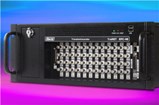
Flexible Configuration and Up to 64 Channels Enable Use in Variety of Industrial and Science Applications
Elsys Instruments, a leading manufacturer of custom and standard, fast, high-precision data acquisition systems, now offers the TraNET EPC, a complete transient recorder system that provides up to 64 channels in one system. The new system combines Elsys' family of high-speed LAN-controlled instruments featuring multiple acquisition modes with a series of robust industrial computers designed for high-precision measurements in industrial environments.
The flexible TraNET EPC enables configurations designed to users' unique measurement needs, making it ideal for a diverse range of power measurement applications including verification and testing of electrical engine control systems, inverters, frequency converters, power plant maintenance and particle accelerator control.
More specialized applications include connector pin resistance testing, ballistics, explosive testing and preventive seismic and structural health testing. The unit's LAN connectivity allows standalone operation, so TraNET EPC can reliably be deployed in mobile and remote environments as well.
TraNET EPC can be equipped with up to 16 of Elsys' TPCX PCI-compatible digitizer modules that feature unique measurement precision of typically ±0.03%, sample rates up to 240 MS/s at a vertical resolution of 14 bits (up to 30 MS/s at 16 bits) and acquisition memories up to 128 Mpoints per channel.
Available in 8-, 16-, 24-, 32-, 48- and 64-channel versions, the scalable TraNET EPC can be coupled and synchronized for clock and trigger with the unique "Sync-Link Box" for up to 512 parallel channels.
With Elsys' powerful TransAS 3 software, TraNET EPC becomes a turnkey solution enables both quick configuration of acquisition channels as well as a post-processing analysis of complex waveforms. In addition, two entirely separate instrument functions can run on a single EPC backplane using TransAS 3.
Elsys' complete TraNET series of transient recorders feature several data acquisition modes. Scope mode, similar to an oscilloscope, enables the quick configuration of the acquisition parameters before working in a different mode or simply the ability to visualize and analyze single-shot events.
In continuous mode (data recording, writing or streaming), data is acquired and written onto the internal hard disk at a maximum total data transfer rate of up to 40 MS/s with no loss of data or dead times between events. The capture length is limited only by the size of the hard disk.
Block mode divides the available onboard data acquisition memory into absolute or relative time-stamped blocks, especially useful for capturing signal bursts where only relevant data needs to be recorded. Dead time between blocks is in the range of a few sample intervals.
As the most sophisticated data acquisition mode available, event controlled recording (ECR) is ideal for troubleshooting and long term monitoring applications. ECR mode requires a trigger event, but eliminates the dead time between triggers using an overlapping technique of adjacent acquisitions. In addition, every channel can acquire waveform data independently on trigger command as well as synchronously with associated channels.
In ECR mode, the time stamped events are recorded first in the onboard memory, which uses a ring-buffer architecture, and are then written off to the internal hard drive. As long as the streaming rate keeps up with the data trigger rate, this mode can run until the hard drive is full.
The well-established Elsys TPCX data acquisition modules, the heart of every TraNET EPC system, offer many sophisticated features such as single-ended and differential inputs, large input voltage and offset ranges, advanced trigger capabilities with an external trigger, programmable anti-aliasing filters as well as ICP input for piezo sensors and digital inputs.
For more information, visit http://www.elsys-instruments.com/english/tranet.html
SOURCE: Elsys Instruments