
Global Hydro defines "clean" for turbine lube-oil systems
By Cathy Swirbul
Contents
An unexpected beginning
Skipping to the present
An investment and a future
Sidebar: Global Hydro: A CEO's perspective
An unexpected beginning
When Alfred Meyer woke up one day in late 1981, he didn't realize a power plant crisis would sweep him into a new line of work. He and his two partners from W.W.A. Mobile Hydro Blasting (now Global Hydro Service) set out that day to promote the use of water blasting in pipe cleaning. He was setting up his unique water-pump apparatus to demonstrate sewer cleaning while, coincidentally, power plant personnel were starting a large steam turbine. Just before the unit was to go online, the previously flushed lube-oil system was found to be re-contaminated. There wasn't time for the lengthy process used to flush the turbine generator's lubricating oil system.
Meyer offered to use his water-pump equipment, a unique combination then, to blast metal fragments out of the oil system lines. Holes were cut for access and as much of the system as possible was cleaned. Meyer's equipment combined high pressure and high volume to achieve two things: the high pressure scoured the lines while the high volume of water flushed the dirt and debris clear of the lines.
In a stroke of genius, high-viscosity turbine oil was blasted through the system in the final flushing to eliminate any remaining water and to overcome the engineers' objections to using water in a lube oil system. The technique proved much more effective than the commonly used method of flushing merely with oil.
When the flushing was complete and deemed an overwhelming success, Meyer and the General Electric engineers on site realized they had something. Over the next two years, they refined hydro blasting to the point where it could be incorporated into existing oil-flush procedures.
They selected a rust inhibitor for its compatibility with turbine lube oil and turbine-generator components. The men collaborated with pump and nozzle manufacturers to develop special equipment for hydro blasting turbine lube-oil and water-cooling systems. The refined hydro-blasting method employs pressure of up to 10,700 pounds per square inch, volumes of up to 75 gallons per minute, and rotation speeds of up to 10,000 revolutions per minute.
Twenty years later, Global Hydro's procedure still is featured in the General Electric Turbine Engineering Manual EM2265 and in the company's Technical-Information Letter TIL 972-3A.
Skipping to the present
Brett Harford and Matt Anderson, now chief operating officer and technical team leader respectively, took over leadership of the company in 1997 after Meyer became ill. The company name was changed to Global Hydro Service to reflect expanding operations in Europe. Today, the company operates two sets of equipment in the U.S. and one set based in Germany to serve Europe. Depending on the volume of projects, Global Hydro employs up to 26 people to work on hydro-blasting projects.
To date, Global Hydro has completed more than 650 projects worldwide on nearly all major turbine designs, including General Electric, Westinghouse-Siemens, Allis Chalmers, ABB, and Pratt and Whitney. The company's unique processes substantially reduce lube systems flush times by about 50% from 14 days on large units to seven days. The processes also improve final system cleanliness for new installations, return-to-service and operating units.
The cleanliness of lube oil systems has proven critical to power plant operations. According to a National Energy Research Council study, lube-oil contamination causes one out of three turbine-generator bearing failures.
According to Tim Britton, Global Hydro's CEO, the company's most effective advertising has been customer recommendations. Potomac Electric Power Company hired Global Hydro to blast a turbine-generator lube oil system that had been flushed for 21 days and kept getting re-contaminated. Global Hydro effectively flushed the system in four days with no re-contamination.
"Global Hydro's professionalism and dedication on the job to get the desired results was first class," said Barres Jackson, turbine engineer at Potomac Electric Power Company.
GE/GETSLO has used Global Hydro's services for nearly 20 years throughout Spain, Rumania and Israel. "I recommend them to any power generating company," said German Cano, field service engineer at GE/GETSLO.
In addition to using its hydro blasting services, Global Hydro customers have the option of becoming members of the Global Hydro Referral Partner Network. Network members receive a regular newsletter containing useful industry information, and a current network member directory that can be used to contact other generation professionals to obtain feedback and advice. Currently, 17 power generating companies belong to the network, including Detroit Edison, Entergy Power & Light, Kansas City Power & Light and Reliant Energy.
An investment and a future
Global Hydro staff increasingly is asked to hydro blast water-cooling pipes, boiler-feed pumps and other ancillary systems. The company's only limitation was the size of its operations. However, that situation changed in April 2000 when Global Hydro was acquired by a group of investors, the Arthur and Dennis Companies. Global Hydro has since opened a dedicated customer service facility in San Luis Obispo, CA and plans to add five more sets of hydro blasting equipment. Beginning in fall 2001, the company also plans to offer a condenser cleaning service using hydro blasting.
"We have been asked many times over the years to do more for our customers – more services and cleaning," said Harford. "Due to limited financing and our insistence on maintaining standards, we have had to turn down opportunities. This injection of capital and expertise will allow us to grow rapidly and meet the demand for our specialized services, while keeping the quality to the level everyone expects."
Greer Arthur from the investment group shared his enthusiasm for the enterprise. "Global Hydro Service has everything we look for in an investment—great technology, a great customer service reputation and a growing market demand," Arthur said. "We have high expectations for the future."
For additional information, check out Global Hydro's Power Online Storefront, or contact Tim Britton, Global Hydro's chief executive officer, (815) 787-0418 or timbritton@globalhydro.com.
Global Hydro: A CEO's perspective
By Cathy Swirbul
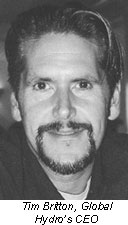
In this age when companies are encouraged to diversify, Global Hydro has maintained a single focus – hydro blasting lube-oil systems of power-generation turbines and ancillary cooling water systems. That determination has paid off in a business spanning two decades and a shot at a thriving future. Tim Britton, Global Hydro's CEO, joined the company in 1999, following his yearning to join a small-scale, start-up company. He spent the previous few years working at Fortune 500 companies, including General Electric and TransamericA. He offered his insights into the Global Hydro story.
 Q. What were some of the obstacles GHS faced in its early development and how were they overcome? Were there many other companies offering similar services at that time?
A.
The challenges facing Global Hydro are similar to those faced by many small companies offering skill-based services—cash flow, key staff retention and effective sales coverage. The issues are compounded because the core customer base is the power generation industry, which conducts maintenance on a seasonal basis. In the current power -squeeze conditions in the West and under newly privatized/deregulated generation ownership, maintenance is being cut back or postponed.The lube-oil system is critical to the turbine's ability to spin continuously. There is some false sense of security in turbine robustness and the faith being placed in oil conditioners. The lube-oil system design means that the pipe is constantly rusting. In coal fired units, soot continually builds up, especially those with pressurized boiler systems. A large thermal shock to the system will release large soot fragments that can block the oil strainers at the bearings and restrict flow. The result is higher than normal bearing temperatures and possibly a forced outage. In the longer term, we will see more work due to forced outages.
The large non-specialized industrial cleaning conglomerates, such as Hydro-Chem, CEDA or SMSI, are our largest competitors. They have no shortage of capital but tend to be generalists. Our teams are specialists in turbine-generator lube-oil systems.
Q. How has the GHS hydro-blasting equipment changed over the years to make it more effective?
A.
We have worked hard to make our process clean overall, not just in the hydro blasting. In terms of equipment, we use customized fittings to do specific pipe configurations, which allows us to seamlessly change from water to oil.Q. Describe your most challenging hydro-blasting project and how the challenges were overcome.
A.
The worst challenge is always the large de-commissioned unit that has been left to rust for 20 years. In the go-go days of deregulation, this unit is now a prime generating asset. We have been asked to clean lube oil systems in which there has been no oil in the lube-oil system for 20years and the reservoir has been left open to the elements. We have found nesting birds in the lines. We overcome the challenge by hard work and attention to detail.Q. What year did Arthur and Dennis Companies acquire the company?
A.
The investors acquired a majority interest in early 2000 after discussions over a period of 18 months. They have interests in businesses that solve service problems using skills and applications of technology, yet are not pure technology companiesQ. How are you specifically expanding operations?
A.
We are adding high-velocity oil flushing and filtration services. To do this, we have partnered with Marine Industrial Contractors of Pascagoula, MS, which specializes in offshore and process-system flushing. We also are working with Benchmark Services, which is focused on the power industry but regionally concentrated in the Southeast. Both companies have excellent reputations and good equipment availability. Our market coverage and European presence helps them expand and we are able to leverage their flushing capabilities. Our teams have worked together now on several large projects and as we move forward, we may formalize our strategic alliances.Secondly we plan our services outside of the lube oil system flushing. One technology we are exploring is a liquid-abrading system patented by a UK company that combines water, air and an abrasive in variable amounts to give an abrading tool that can be gentle enough to polish fingernails or aggressive enough to remove baked-on ceramic finishes. We see great potential for this in its ability to clean fragile precipitator plates in the stack scrubbers. This technology is better than anything we have found available in the U.S.
Q. Explain the new condenser cleaning service you plan to add in the fall.
A.
With great commercial pressure in today's power generation industry, a key measure of productivity is heat rate – the amount of BTU per kWh expended. The main condenser has a huge effect on the efficiency of the generator as the condenser pressure technically represents the turbine back pressure. Each condenser has an assumed 85-percent cleanliness rating. When delivered, the condenser's cleanliness rating is 100 percent but as the tubes silt up, the volume of steam cooled reduces.As the cooling surface area gets reduced and flow rate drops, the back pressure goes up. This problem is not new. The industry has developed predictor models that show rate of efficiency decline and predicts when the condenser needs cleaning. Using current methodologies, this has been up to three times per year, depending on individual plant and local water variables.
The methods used have ranged from brushes, cleaning plugs and high pressure water and involve in-house maintenance in unpopular and dirty work. Inevitably the generating companies have had to outsource much of the effort. Some trials have been held using automatic condenser cleaners but they have proven to be expensive and they wear out. Global Hydro has been successful in leveraging its high-pressure water cleaning competency to develop a technology application that allows 200 tubes per hour to be hydro blasted.
This enables a level of clean that is acknowledged as being the best achievable by any process with no streaking. The speed of the specialized hydro blast equipment enables the process to be price competitive with less efficient methodologies. We use existing brush cleaning technologies, such as the Robinson gun, and tools where time limits on access will not allow the moiré effective hydro blasting.
Global Hydro's technology uses 7-15,000 pounds per square inch of water at 15-25 gallons per minute and allows four tubes per minute to be cleaned on a sustained basis. The equipment is air propelled with a pre-set throw into and back out of the tubes, which is safer than most other hydro blast methodologies, is self contained and is operated by a three-man Global Hydro team.
Q. What are some current trends in the power generation industry for which GHS is designing new services?
A.
The fact that the planned maintenance efforts are being reduced or stretched out over longer time horizons has been driving our efforts to diversify. One of the big efforts we have made has been to expand into the new installation cleaning services. Adding flushing allowed us to expand into gas-turbine installation start-up cleaning.Hydro blasting is the most effective cleaning method for large on site welded pipe systems but most are small aero-derived gas turbines, which make up the bulk of new generation capacity and do not need any aggressive cleaning. However, we have worked with Calpine on a method of cleaning large-scale, exhaust-driven air-cooled condenser stacks. Normally, these are cleaned roughly by the welding contractor then cleaned with a steam blow at start up. This entails running the gas turbines to build the steam pressure and temperature up to stress the system to the degree that loose metal will be dislodged in the expansion and contraction process. It is time consuming to fire it up, hold it at temperature and pressure, allow it to cool and be inspected, clean out debris and then repeated until everyone is happy.
In today's marketplace if we hydro blast the welds clean while they work on other parts of the system, they can reduce the steam blow to a minimum and generate revenue while previously they still would be steam blowing. At $300,000 to$1,500,000 a day for a 500-MW unit in peak season, a savings in lost revenue is a big deal.
Q. Describe the culture within your organization.
A.
Global Hydro is a typical small company. Everyone wears many hats and customer focus is ingrained from day one. The crews are young. We are located in the central coast of California so we have our fair share of surfers and guys living on ranches. Our project-based work suits their lifestyles as they work for three weeks then are off for two weeks or so.Q. What differentiates GHS from other companies doing similar work?
A.
I think we are very aggressive in marketing and being international helps us obtain international projects. Global Hydro is led by a New Zealander (Brett Harford, chief operating officer), a Canadian (Matt Anderson, technical team leader) and I am English. We have a long service reputation.Q. How would you describe your leadership style?
A.
This is a small business, rather than a large division or operating unit, so I'm required to be more hands on and less visionary. I still try to lead by example and ensure we hire the best and give them an opportunity. A small company needs team integrity and the guys doing the job every day are the most critical asset.Q. Describe what you envision Global Hydro to be one year and then five years from now.
A.
In one year's time, I see us being further along the road that we have started down in the last year. The new diversifications will be up and working or we will have moved onto something else. In service businesses, it takes time to build trust and reputation so in five years time, we will see the real fruits of our efforts. I hope we are the most successful cleaning services provider to the power generation industry on a global basis. Our success is defined in terms of customer reputation and our ability to keep growing and renewing.
About the author: Swirbul specializes in writing for the power industry, as well as for business-to business and business-to-consumer Web sites. She can be reached at cswirbul@unicom.net.
Subscribe to our free e-mail newsletter.
Click for a free Buyer's Guide listing.