
Gas Turbine Emission Control Considerations

 Table of contents
New Environmental Siting Report
Air Quality Siting and Permitting Regulatory Issues
Low-NOx Burners Offer Benefits and Trade-Offs
Ammonia Slip Issues
About the author
In the past two years, the number of gas turbine purchases by power producers has increased dramatically. Concurrently, emission limits throughout the country for nitrogen oxide (NOx), carbon monoxide (CO), particulate matter (PM10), and volatile organic compounds (VOC) are becoming more stringent. The technological and regulatory complexities of air quality compliance can significantly delay or add cost to power generation projects, or even result in project cancellation. Power producers are seeking to understand the potential complexities that may arise, their solutions, and the project characteristics that may trigger these circumstances.
New Environmental Siting Report (Back to top)
A recently-released EPRI report (www.epri.com), Gas Turbine Environmental Siting Considerations, (EPRI 1000651) presents pertinent information for power producers faced with air quality permitting decisions for combustion turbines in today's rapidly evolving technical and regulatory environment.
The report compiles the most recent information on the siting, environmental compliance and permitting of gas turbine power projects. Specifically, it discusses current air quality permitting requirements, and the capabilities and limitations of emission control and measurement systems to meet these requirements. In addition, the report includes an overview of the air permitting process with an in-depth examination of local permitting requirements for the areas of the country with the most stringent emission limits. The report also addresses emerging trends in air permitting, including the increasingly stringent emission levels for NOx, CO, VOC, and PM10, and the increased emphasis on measurement and control of organic air toxics such as formaldehyde and polycyclic aromatic hydrocarbons (PAH).
Air Quality Siting and Permitting Regulatory Issues (Back to top)
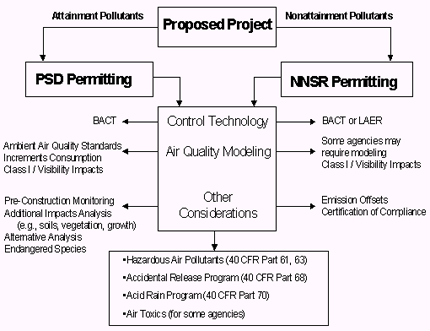
One of the most important aspects of a successful gas turbine project is site evaluation and suitability, which involves not only an infrastructure evaluation but also consideration of whether the gas turbine project can meet an air agency jurisdiction's requirements. The stringency of emission levels is typically based on whether a source is sited in an ozone attainment or nonattainment area (see Figure 1). The air quality regulatory requirements for siting and permitting a gas turbine are based on (a) estimating emissions to determine regulatory applicability; (b) identifying applicable permit requirements (e.g., control technology requirements, emission offsets, and air quality modeling impacts); and (c) considering other regulatory requirements such as air toxics impacts and regional impacts.
Figure 1. Overview of Air Quality Permitting Requirements
Low-NOx Burners Offer Benefits and Trade-Offs (Back to top)
A key technology for nitrogen oxides control is low-NOx burners. Conventional combustors are diffusion controlled, where fuel and air are injected separately; combustion occurs locally at stoichiometric interfaces, which can generate hot spots that produce high levels of NOx. In contrast, DLN combustor technology premixes air and a lean fuel mixture that significantly reduces peak flame temperature and thermal NOx formation. Another important advantage of the DLN combustor is that the amount of NOx formed does not increase with residence time. Since long residence times are required to minimize CO and unburned hydrocarbon (UHC) emissions, DLN systems can achieve low CO and UHC emissions while maintaining low NOx levels. For selected turbine models, Table 1 shows the guaranteed NOx levels for DLN combustors that major CT suppliers offer.
Table 1. DLN Combustor Guarantee Levels for Selected Turbine Models
|
Manufacturer |
Turbine Model |
Power Output (MW) |
Guarantee Level – Natural Gas (ppm at 15% O2) |
|
General Electric – Frame Series |
7FA plus enhanced |
170 |
9 |
|
7FA plus |
170 |
15 |
|
|
7FA |
170 |
25 |
|
|
7EA |
83 |
9 or 25 |
|
|
6B |
38 |
9 or 25 |
|
|
General Electric – Aeroderivative |
LM6000 |
42 |
25 |
|
LM2500 |
23 |
25 |
|
|
Siemens-Westinghouse |
V84.3a2 |
170 |
15 |
|
V84.3 |
154 |
25 |
|
|
V84.2 |
106 |
9 or 25 |
|
|
501G |
250 |
25 |
|
|
501F |
185 |
15 or 25 |
|
|
501D5 |
115 |
25 |
|
|
Alstom (formerly ABB) |
GT24 |
166 |
25a |
|
GT13E2 |
165 |
25a |
|
|
GT10C |
30 |
15 |
Note (a): Alstom has indicated that it is probable that these machines could be guaranteed at 15 ppm, though all units sold to date have used SCR for NOx control and guarantee lower than 25 ppm has not been required.
However, DLN burners pose trade-offs. Due to flame instability limitations of the DLN combustor below approximately 50 percent of rated load, the turbine is typically operated in a conventional diffusion flame mode at low load levels, resulting in higher NOx levels. DLN combustors also tend to create harmonics in the combustor that may result in vibration and acoustic noise. In addition, O&M costs for turbines equipped with DLN can be higher than expected due to a variety of factors, including replacement of blades and vanes due to damage resulting from dynamic pressure pulsation, and combustor sensitivity to changes in fuel composition. DLN combustors can also experience "flashback," in which fuel upstream of the burner ignites prematurely, damaging turbine components.
Virtually all DLN combustors in commercial operation are designed for use with gaseous fuels. Some manufacturers are now offering dual-fuel DLN combustors. However, DLN operation on liquid fuels has been problematic due to issues involving liquid evaporation and auto-ignition. This consideration becomes more important as power producers consider converting from natural-gas-only to dual-fuel operation as natural gas prices rise.
Ammonia Slip Issues (Back to top)
The most common NOx control method for new combined cycle power plants permitted at or less than 9.0 ppm is a DLN combustor combined with a selective catalytic reduction (SCR) system. SCR is a mature technology, with hundreds of installations currently operating in the U.S. on gas turbines, boilers, and internal combustion engines. SCR uses ammonia as the reducing reagent in the catalytic process, and a certain amount of ammonia may pass through the catalyst unreacted and be emitted as "ammonia slip." Many state and local air quality agencies consider ammonia to be a hazardous material. In most cases, ammonia slip is currently limited by permit condition to either 5 or 10 ppm at 15 percent O2.
In addition to pollution concerns, ammonia slip typically results in a number of challenges. Ammonia in a turbine's exhaust gas can lead to fouling of heat recovery steam generator (HRSG) tubes downstream of the SCR if moderate quantities of sulfur are present in the flue gas. Ammonia and sulfur can combine to form ammonium bisulfate, a sticky substance that forms in the low temperature section of the HRSG (usually the economizer). The deposited ammonium bisulfate is difficult to remove and can lead to a marked increase in pressure drop across the HRSG.
SCR vendors guarantee ammonia slip levels as low as 2.0 ppm if additional catalyst is added to the SCR. The additional cost of this catalyst is relatively small compared to the base cost of the SCR designed for 10 ppm ammonia slip, adding 15 to 20 percent to the equipment cost. A new catalyst has essentially no ammonia slip, due to the high activity level of the catalyst when it is fresh. Over time, however, the activity level of the catalyst slowly declines, and the amount of ammonia slip slowly increases to maintain the NOx concentration at or below the NOx guarantee level. Using fresh catalyst, an oversized SCR reactor, and a substoichiometric ratio of ammonia to NOx (such as 0.9 to 1.0), results in relatively complete consumption of ammonia in the SCR reactor, while still achieving the NOx outlet concentration requirement of 2.5 ppm.
Two "zero ammonia technologies" have recently emerged to compete with SCR for the ultra-low NOx power generation market. These technologies include SCONOx™ and catalytic combustion. SCONOx™ has been in operation on an LM2500 since 1996 and has consistently maintained a NOx level of less than 2.5 ppm. Catalytic combustion is in the process of being commercialized; a small Kawasaki turbine maintained a NOx level of less than 3.0 ppm in a 4000-hour test conducted in 1999. In addition, an ammonia degradation catalyst may be used to eliminate any ammonia slip that passes through the SCR, resulting in essentially zero ammonia emissions at the stack.
This article is based on EPRI report 1000651, "Gas Turbine Environmental Siting Considerations," prepared by S. Rivera of Resource Catalysts and B. Powers of Powers Engineering, December 2000. For more information in this area, contact EPRI's John Scheibel, jscheibe@epri.com, (650) 855-2850.
About the author (Back to top)
Steve Hoffman is president of Hoffman Publications, Inc. (www.hoffmanpubs.com), a California-based firm that specializes in writing for the energy industry. Steve is a frequent contributor to ElectricNet and authors a monthly column entitled "Plugged In with Steve Hoffman" for ElectricNet.
Subscribe to our free e-mail newsletter.
Click for a free Buyer's Guide listing.