
Creating potential revenue gains with CFD simulations
By Bernard Massé, Hydro-Québec Institute of Research
Table of Contents
Less efficiency than expected from one of its plants prompts Hydro-Québec to turn to CFD
Eliminating several areas from consideration
Selecting FEA-based CFD software
Reducing the losses
Effects of new design on erosion
CFD simulations helped engineers at Hydro-Québec make design changes that will generate revenue gains of up to C$5 million in 12 hydropower turbines. By shifting the maximum efficiency point to raise the power output by 7.8 MW and by raising the weighted efficiency of the turbine by 1.6%, the company expects the changes to produce revenue gains of between C$200,000 to C$500,000 per year for each turbine.
The exact amount depends upon the grid demand. With these revenue gains already validated in one turbine, the company plans to implement the design changes on the other 11 turbines. Hydro-Québec achieved these gains by modifying the runner at the blade trailing edge to eliminate a large eddy in the draft tube elbow. This eddy reduced efficiency of the turbines. To discover the eddy and validate design changes, the company used CFD, providing researchers with a clear understanding of fluid flows throughout the turbine.
Hydro-Québec ranks as a world leader in generating "green energy," with more than 31,400 MW of installed capacity in 1998 and ranks among North America's largest distributors of energy. It serves 3.5 million residential, commercial, institutional and industrial customers in Québec.
Also, the utility supplies nine municipal systems, one regional cooperative, and some 15 electric utilities in the Northeastern United States, Ontario, and New Brunswick. Since obtaining a marketer's license from the U.S. Federal Energy Regulatory Commission (FERC), it also makes direct sales, at market prices, to American power wholesalers, including public utilities, municipalities, resellers, and large industrial consumers in the United States.
Its 1998 sales totaled 161.4 TWh, with Québec markets accounting for more than 88% (142.8 TWh) and sales outside Québec for nearly 11.5%. The company is a publicly owned company with a single shareholder, the Québec government.
Less efficiency than expected from one of its plants prompts Hydro-Québec to turn to CFD
Hydro-Québec found that one of its power plants, commissioned in the early 1980s, operated with less hydraulic efficiency than it expected from the reduced scale model tests conducted by the manufacturer and confirmed by an independent test stand. When the power plant was originally built, there wasn't any way to determine what went wrong in the design and fabrication of the 12 identical turbines used in the plant.
Because of the tremendous advances since that time in numerical simulation tools, Hydro-Québec decided to take another look at this problem with the goal of finding the cause and, ultimately, a solution to raise the efficiency of the turbines.
CFD, the technology used in this simulation, involves the solution of the governing equations for fluid flow at thousands of discrete points on a computational grid in the flow domain.
When properly validated, a CFD analysis allows engineers to determine the direction and speed of flow at any point in the flow domain. Unlike a physical model, the geometry of the CFD model can be changed quickly on the computer and re-analyzed to explore different options in project design or operation conditions.
The plant conducted fluid flow simulations in the whole turbine from the water intake through the penstock, the spiral casing, the distributor, the runner, and the draft tube. To compute the flow inside a complete turbine, requires iterations to link the components, distributor, runner, and draft tube.
Velocity profiles, turbulence parameters, and pressure distributions must be transferred from one component to the other to assure a coherent flow through the entire turbine. For a given operating condition, the mass flow and wicket gates angle are specified to compute the distributor flow field. This gives the velocity profiles and turbulence parameters to be used as runner inlet flow conditions.
Users then compute the runner flow and use outlet profiles as draft tube inlet conditions. Hydro-Québec then computed the pressure as the flow solves in the draft tube and uses runner outlet boundary conditions to recalculate the flow. The same is done with pressure at the distributor outlet. (Return to Table of Contents)
Eliminating several areas from consideration
Fluid flow in the water intake and in the penstock is responsible for the flow profile entering the spiral casing. Questions came up about the velocity profile at the entrance of the spiral casing due to the presence of an elbow just upstream and also because the flow at the water intake itself arrives at various angles.
Experimental measurements were available on a scaled model of the water intake where the shape of the reservoir had been reproduced and the inlet angle could be changed. The CFD analysis correlated well with the model measurements and didn't show any anomalies, leading analysts to believe that the efficiency problem wasn't related to the water intake or the penstock.
The analysts simulated flow field in the spiral casing to check for problems. The contour of radial velocities generated by the analysis indicated that the flow at the runner inlet remained uniform along the circumference. Also, they didn't see a problematic flow pattern in the spiral casing.
Analysts then suspected the problem resided in the turbine itself. Because the flow remained uniform in the distributor, they modeled a section of the distributor for flow simulation and loss computations. To investigate the flow in the runner, they measured two hydraulic passages on site. To measure the surface data of critical parts (leading and trailing edges and complex surfaces of the blade), they used a mechanical digitizing arm. (Return to Table of Contents)
Selecting FEA-based CFD software
Hydro-Québec researchers selected the FIDAP CFD code from Fluent (Lebanon, New Hampshire) as one of their modeling and analysis tools. This software package uses the finite element approach and has the advantage of using non-structured grids.
Non-structured grids provide considerably greater flexibility in modeling the complex and irregular geometries involved in hydropower turbines. Non-structured grids also automate the otherwise impracticably tedious process of fitting elements to the complex geometries used in complex areas such as the draft tubes.
Care was taken to ensure good mesh quality, especially near the walls, which are responsible in large part for the losses. Using the iterative approach described earlier, the analysts computed several turbine operating conditions.
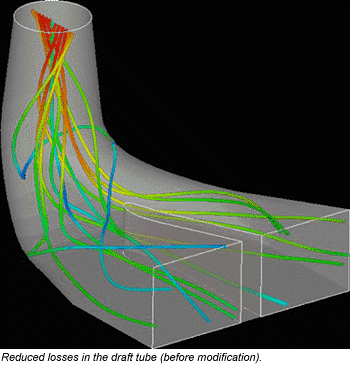
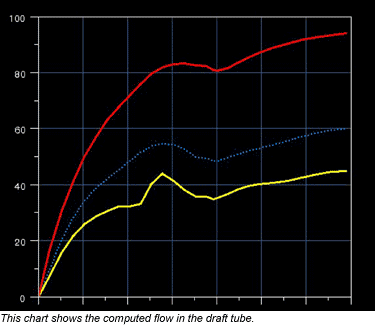
The simulation in the turbine showed a large eddy in the elbow. Further analyses led researchers to conclude that this phenomenon caused the efficiency problem. The eddy arises just before the peak operating point and up to the maximum load. It relates to inappropriate flow at the runner exit. The runner-draft tube interaction caused most of the losses. However, analysts detected another smaller eddy in the runner, near the leading edge and the crown on the pressure side of the blade. (Return to Table of Contents)
Reducing the losses
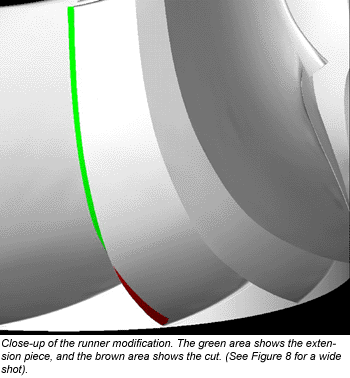
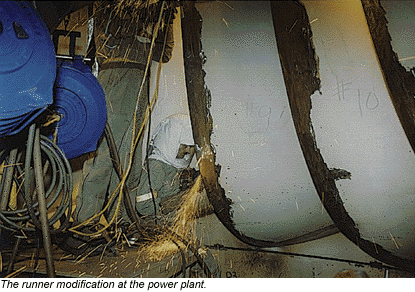
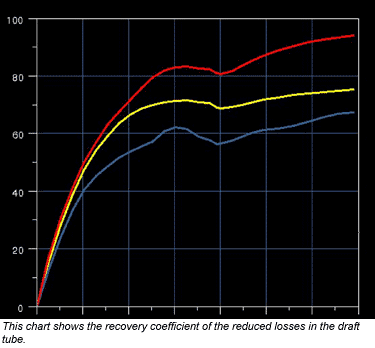
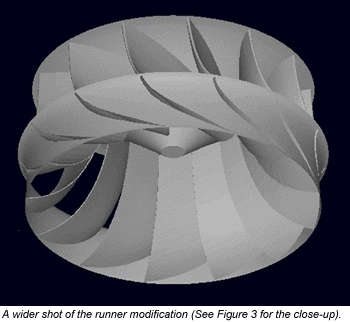
To reduce the losses, the water flow between the runner and the draft tube had to be improved. Researchers chose to modify the runner outlet and designed a new trailing edge. They conducted a parametric study on the draft tube flow to determine the influence of the inlet flow parameters on its performance.
Several blade cuts and extensions were tried to modify the critical parameters. Once the draft tube flow was optimized, they examined the flow in the runner to reduce, if possible, runner losses at the same time. The researchers arrived at a solution that reduced hydraulic losses in the runner as well as the draft tube at the maximum efficiency point.
The efficiency measurements on the prototype, measured by an independent team, showed a significant increase in turbine efficiency at all operating conditions. The gain is about 1.5% at the peak and increases as the operation moves to the maximum power point.
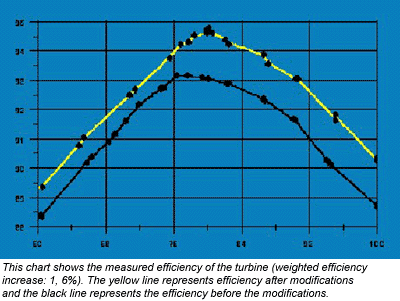
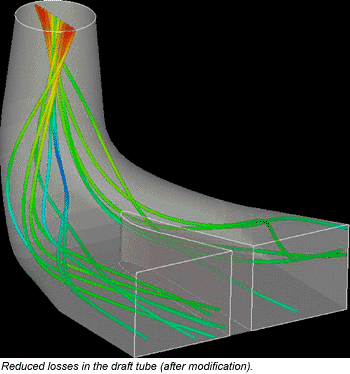
At the maximum efficiency point, the gain comes from the improved flow both in the runner and in the draft tube elbow. In the draft tube, analysis results showed that the eddy in the elbow was gone. In the runner, the effect of the eddy is reduced. The maximum efficiency point is shifted to the right and gives an additional 7.8 MW to the 195 MW nominal unit with 1.5% more efficiency. (Return to Table of Contents)
Effects of new design on erosion
Researchers also looked at the effects of the new design on cavitation erosion. The CFD results indicated an increase of inlet cavitation with the modified runner. Measurements using a vibratory cavitation detection method before and after modification indicate a possible increase of 30% in erosion at the maximum efficiency point and an increase of 85% at maximum power.
However, Hydro-Québec didn't consider this increase to be a serious problem since the original runner cavitation level remained low. The increase in efficiency far more than compensates for the expected small increase in maintenance costs.
Hydro-Québec first applied the modifications to a single Francis turbine. The modified turbine provided more than the increase in efficiency predicted by the analysis. In less than a year of operation, this improved efficiency has already paid for the C$200,000 cost of the modifications. Hydro-Québec plans to use CFD for modifications on the other 11 turbines for this power plant.
Planning is also in progress to use CFD to improve turbine efficiency at other power plants within the Hydro-Québec system. This application provides an excellent illustration of how CFD simulations can identify hydropower problems and help develop alternatives to improve machine performance.
About the author: Bernard Massé serves as hydraulic machines team leader for the Hydro-Québec Institute of Research in Varennes, Québec, Canada. For more information about Fluent and its work with CFD, contact (in the United States) 10 Cavendish Court, Centerra Resource Park, Lebanon, NH 03766, 603-643-2600, fax 603-643-3967, or visit www.fluent.com.
Edited by April C. Murelio
Managing Editor, Power Online