
China wakes up to wind
By Tim Sharp
A major new wind power market that could be up in as little as three years is quietly taking shape in China. It will be primarily coastal, not far inland as previously thought. It will therefore be within tens of kilometers of many of the country's main load centers and consequently much more viable.
In the longer term, the coastal resource is likely so vast that if combined with pumped storage hydro, it could radically change China's energy calculus. Significantly, most of the technology is already available. Prices are near competitive. Outstanding problems are already being tackled.
The conventional view of China's wind power resource is that it is vast but largely inaccessible.The national "practical wind potential" at 10m height is commonly given as 253 GW, equivalent to five sixths of the country's present installed capacity.
But roughly half this potential occurs in the sparsely populated far northwest of Inner Mongolia, Xinjiang and Gansu provinces. It therefore encounters the same problem of getting it to Southeastern markets that afflicts China's coal and gas supplies.
The issue even prompted a 1996 joint Ministry of Electric Power/Princeton University study that outlined how remote oversized wind farms could be twinned with nearby energy storage to deliver base-load power to the east coast for lifetime levelized costs of 3-4 cents/kWh. (See "Evacuating wind" below.)
Evacuating wind
Competitively priced wind power from Huitengxile, Inner Mongolia could be supplied to China's East Coast if consistent optimum loading of the necessary high voltage transmission lines was achieved, a November 1996 study found.
Consistent optimum loads would be achieved by "overbuilding" the wind power site so combined turbine nameplate capacity exceeded powerline capacity, and by providing energy storage.
Thus transmission line capacity would be reached when the entire farm was operating at wind speeds somewhat below their mean. As wind speed increased, excess energy would be stored either as pumped storage or as compressed air energy storage (CAES) typically provided by old mines.
When wind speeds decreased to below powerline capacity, stored energy would be released to compensate for turbine shortfall, in effect providing base load power to the east coast.
Source: Industrial-scale wind power in China: Center for Energy and Environment Studies, Princeton University and Ministry of Electric Power, Beijing. November 7, 1996.
The prospect is so tantalizing that even though the necessary storage hasn't yet been identified (CAES would be cheaper) the most accessible sites at Dabanchang in Xinjiang and Huitengxile in Inner Mongolia already host almost half present national installed wind capacity of 262 MW at the end of 1999. (See "China's potential and installed wind power capacity" table below.)
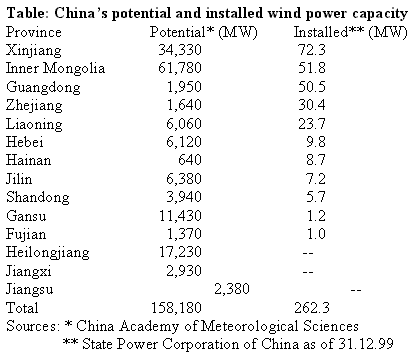
Huitengxile is also the site of China's largest single wind project to date, 100 MW out of a total 190 MW under a June 1999 World Bank project being installed there. The remaining 90 MW is slated for Hebei, with 50 MW and 20 MW each in Fujian and near Shanghai.
Hence the conventional view: China's wind power sector is still development assistance territory, still miniscule, still inland-focused. There is in addition only limited local equipment manufacturers and no commercial infrastructure to get deals done.
But things are changing very fast. For instance, grid-connected installed capacity has risen from 57 MW in 1995 to 167 MW in 1997 and 260 MW by the end of last year, according to Chinese data. Some 900 MW of funded new capacity is in the pipeline, typically off turbines rated at 600 kW or better.
Similarly over the same time frame, national wind power capacity targets have risen from 1 GW by 2010 to 3 GW by the same date to 5 GW by 2005.
The Institute of Electrical Engineering (IEE) of the Chinese Academy of Sciences set the first one in 1997, the State Power Corporation (SPC) the second in 1999, and a joint Chinese-United States Technology Cooperation Agreement Pilot Project (TCAPP) wind power expert team the third in February 2000.
Significantly while the TCAPP target may well be informal, it may well also be the most realistic. For if the IEE target will now be met eight years ahead of schedule, the SPC goal must also be far too easy. In addition, it is TCAPP that has shifted the focus of wind power development from inland to the coast.
For perspective, because it is remote, less than half of China's 253 GW Northwest-focused "practical potential" is economic. But coastal wind power generated primarily in China's vast near-shore shallows could more than offset this massive winnowing.
As an example, tiny Nan'ao Island off southeastern Guangdong province already hosts 43 MW of wind power pilot projects, according to SPC data. If just these were replicated along China's 4,000 km coastline, most of it windier than sub-tropical Nan'ao, 100 GW capacity could easily be built, all of it within 50 kms of load centers.
But however inviting this prospect is, it also points up Chinese wind power's largest hurdle: no adequate assessment of the resource exists. Further, China has so far not allocated the huge budget required to map such a vast area, hence no commercial wind farms can set up there.
Yet help is on the way across a very wide range of issues. Here, based on TCAPP's February 2000 study report, are the main issues and responses. If these are implemented as quickly as seems likely, this nascent market could become fully-fledged in as little as three years.
There is no adequate wind resource assessment.
Wind power is still more expensive than that from coal.
Domestic manufacture of wind power equipment is in its infancy.
Domestic technology for wind turbine and wind farm design as well as product certification is inadequate.
Plenty seems to be happening to bring China quickly up to speed. As just one example—besides a continuing stream of bilateral meetings, study tours, seminars and so forth to address the above issues, formation of the Chinese Renewable Energy Industries Association (CREIA) was announced May 1.
Fostered by UNDP, CREIA will "promote sustainable renewable energy development based on market oriented commercialization principles." It will link "regulatory authorities, research institutes and industry professionals."
And also according to its mandate, it also plans to tie in "national and international project developers and investors, promote technology transfer and raise awareness of renewable energy investment opportunities." Very clearly, coastal Chinese wind power is about to take off.
And pumped hydro to store all that energy? Well, Japan's Electric Power Development Corporation (EPDC) is already 18 months into five years of tests on the world's first seawater pumped storage plant.
So just about the time competitive, state-of-the-art wind farms start populating China's coastline, the first operational results from their prospective storage device will also be available.
About the author: Tim Sharp's insight on the Asian power market also appears in his monthly column for Power Online, Logical Output. tsharp@loxinfo.co.th.(Back to Top)