
Innovation for fuel cell plates slashes cycle time, cuts costs
Thermoset leaders Ferromatik Milacron North America, Apex Plastic Technologies, and Premix/Quantum recently collaborated on an injection molding "first" that cuts the cost and production time for a key component used in fuel cells, said Taras Konowal, president of Apex.
The thermoset injection process, he said, replaces the costly and time-consuming compression molding process for making bipolar fuel cell plates, while cutting cycle time significantly. According to Konowal, the breakthrough gives injection molders new opportunities in a market projected to consume 2 billion pounds per year beginning in 2003.
"Widely used in military and space-exploration applications, fuel cells are being aggressively developed by automotive and consumer power companies around the world," Konowal said.
In discussing the fuel cell's tremendous growth in popularity, Konowal cited the prototype buses now operating in Chicago and development plans underway at all the major automotive companies, including Toyota's Fuel-Cell Electric Vehicle (FCEV) and Mercedes-Benz's NECAR.
A typical proton exchange membrane (PEM) fuel cell can use up to 200 plates bolted together in a "stack" similar to a conventional battery. Plate dimensions and weights can vary depending on the design of the fuel cell, he said.
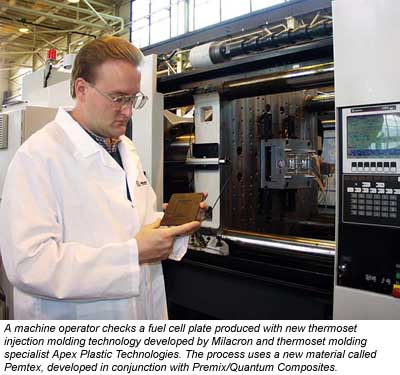
Critical specifications for the plates include flatness, strength and electrical conductivity. But according to Konowal, available materials and molding technology limited the manufacture of these plates to compression molding, a relatively slow process requiring load/unload automation.
To capture this market for injection molding and seize the opportunity, Konowal said, Apex, Premix and Milacron started cooperative development project in 1999. Under this arrangement, Quantum Composites, a division of Premix, created Pemtex, a proprietary, patent-pending, injection-grade, fuel cell molding compound.
According to Konowal, the material initially proved difficult to injection mold, and required technology advancements throughout the injection system and mold, as well as in the machine and control software. Konowal said the companies tested the plates molded with the new injection process and found it to be stronger than compression molded parts, with all the necessary dimensional precision and conductivity.
The new line of BMC thermoset injection molding machines from Milacron and Apex is rated at 100 to 850 tons clamp force. Based on a variety of Milacron machine platforms, the product line uses screw, barrel and stuffer technology from Apex.
The Apex/Milacron team has delivered more than 15 machines since its creation in 1999, moving to a leading American market position in thermoset molding in less than a year, Konowal said.
The machines, he said, process the full range of granular, sheet, bulk, vinyl ester and thick molding compounds. Apex's new servoelectric Revolution stuffer allows continuous processing with the full range of vinyl ester, BMC, TMC and SMC viscosities.
Standard machine features include screw torque limiter and reverse lock, high heat exchanger capacity, heat resistant platen bushings, air-blast flash removal, four electric mold heaters, closed-loop temperature control units for the plasticizing barrel and mold venting/breath cycle.
The new-design Apex injection barrel features a removable water jacket for easier cleaning. The water channel is a double-helix groove, which eliminates hot spots. The swiveling injection unit allows easy screw removal and access to the nozzle. Also, a full range of options is available, including gate cutting, core pull sequences, accumulator-boosted injection speeds, injection compression and extended temperature-controlled nozzles.
Konowal said the injection units feature new screw and barrel technology from Apex. A wide variety of sizes, matched to clamp tonnage, provide phenolic shot capability at the high-pressure end of 1.4 oz/33,400 psi and 44.7 oz/42,000 psi, down to 8 oz/17,065 psi and 151 oz/27,500 psi at the low pressure end.
Capacities with polyester material range from a high-pressure end of 6.32 oz/33,400 psi and 107.8 oz/42,000 psi, to 17.3 oz/13,000 and 431.5 oz/14,000 psi at the low pressure end.
The Apex electric stuffer, he said, allows overlap of plasticating and clamp operations for continuous processing. Stuffer storage capacities range from 100 to 400 pounds. The unit is designed for easy removal from the barrel inlet to aid switching from bulk to granular material. It processes material on a first-in/first-out basis, without dead spots or edges to trap material, and with very low shear to avoid degrading fiber length.
Machine platforms, contact info
Apex injection technology, appropriately sized, will be available on Milacron's Prowler open-frame IMM in 100-, 135- and 190-ton models; Magna hydraulic models to 850 tons; the complete line of Milacron (www.milacron.com) toggle machines, including the Powerline all-electric machines, and Vector vertical insert molding machines.
For more information about Milacron, 888-645-2276, fax 800-282-8082. For more information about Apex Plastic Technologies, contact Konowal, 847-931-9838, fax 847-931-9772 or try these numbers, depending on your location:
- In the United States, Puerto Rico, Mexico and Canada, Greg Fischer, Marketing Support Services, Inc., 3241 Omni Dr., Cincinnati, OH 45245, 888-Milacron, fax 800-282-8082.
- In Brazil, Armando Cristelli, Milacron Equipamentos Plasticos , Estrada dos Casa, 3883-B. Alvarenga, São Bernardo do Campo, SP – Brasil, 011-55-4358-4299, fax 011-55-4358-4443.
- In Argentina, the Caribbean, Central America, Chile, Colombia, Ecuador, Paraguay, Peru, Uruguay and Venezuela, Hector Sosa, Plastec USA, Inc., 7752 NW 74th Ave., Miami, FL 33166, 305-887-6920, fax 305-883-8254.
Edited by April C. Murelio
Managing Editor, Power Online