
Galician Waves Are Best For Energy
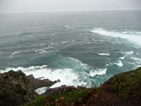
The best coastal areas of the Iberian Peninsula to harness the energy of the waves and the Costa da Morte Bars Stake in A Coruña. This is reflected in two pioneering studies published this month in magazines Energy and Renewable Energy by researchers at the University of Santiago de Compostela (USC).
"The Costa da Morte, between Finisterre and Sisargas Islands, and Bars Stake area-both on the coast Coruña, are those areas of the Iberian Peninsula with the greatest potential for the installation of energy efficiency of the waves," Gregorio Iglesias SINC highlights, co-author of both studies and engineer of the Polytechnic School of USC.
In the investigation, just published journals Energy and Renewable Energy engineers claim that in the Costa da Morte can reach 50 kilowatts per meter of water (over 400 MW / hm per year) and Stake Bars, a little over 40 kW / m.
"From the Northwestern peninsular the energy potential of waves decreases in removal by the Cantabrian Sea to the east (25 kW / m in the Basque Country) and the south Atlantic," says Iglesias, "and the Mediterranean wave force is not adequate to produce energy efficiently.
The study explores the energy potential of Galician waters, and is the first to focus in detail in this region. Researchers have obtained the data from the analysis of maritime climate (solitary waves over time) in deep water of 20 parts of the coast of Galicia. Specifically, the data from four buoys (Langosteira, Vilan-Sigargas, Cape Stake Silleiro and Bars) and 16 nodes in the database SIMAR-44 (time series of atmospheric and oceanographic parameters generated with data collected between 1958 and 2001).
Gregorio Iglesias stressed the importance of the waves as a renewable energy source that can be "crucial" to reduce greenhouse gases and help meet the Kyoto Protocol.
Energy wave
The energy produced by waves, called 'wave' (other than tidal, tidal, high-cost and effective only in coastal areas that can confine large bodies of water) can be generated with various devices. From buoys up and down make a generator, pillars or wells sealed up communications with the sea-air expelled by the waves, pushed into a turbine, through the energy obtained by moving floating and moveable parts together, as the wit Pelamis or "sea serpent" developed in Portugal.
In Spain, for the moment, there are no facilities that operate undimotrices trade, although two pilot plants in Santona (Cantabria), electric buoy heave, and Mutriku (Guipuzcoa), with the technology of oscillating water column. There is also a project to install a wave power plant in the port of Granadilla (Tenerife).
The USC researchers have also developed a system for tidal power generation called "WaveCat", a floating structure that incorporates steel turbines to produce electricity. Currently the team is working on the improvement of numerical models and build a prototype system to scale to test it in a wave tank.
Bibliographic Reference:G. Iglesias, M. Lopez, R. Carballo, A. Castro, J.A. Fraguela, P. Frigaard. "Wave energy potential in Galicia (NW Spain). Renewable Energy 34 (11): 2323-2333, November 2009.
G. Churches and R. Carballo. "Wave energy potential along the Death Coast (Spain). Energy 34 (11): 1963-1975, November 2009.
SOURCE: SINC